
Endometriosis Awareness | Life After Diagnosis
Nothing can prepare you for the idea that in a single day, your body can change and life will be irreversibly worse. Click here to donate to endometriosis research.

Nothing can prepare you for the idea that in a single day, your body can change and life will be irreversibly worse. It’s too frightening, too depressing, too taboo. Parents don’t want to scare their children, doctors don’t want to spike patient anxieties, and we all want to lie to ourselves, blindly believing we’ll always be healthy. I’ve learned the hard way - three times now - that sometimes, life as you know it will end.
March is Endometriosis Awareness Month and I felt compelled to write something about the toll that chronic illness can have on a person. Selfishly, I need somewhere to vent but I also hope that this helps scare someone into keeping a close eye on their health. It is a finite resource and late 20s is a crucial time to start on your preventative care.

Two weeks post-op on my first outdoor excursion. In this image, I have six broken bones and was surviving on Dilaudid.
As some of you know, I was diagnosed with an uncommon bone deformity in my legs four years ago and underwent major, invasive surgery in hopes of correcting it. Blow Number One was that diagnosis. I was 23, very active, and never once considered that I could become disabled out of nowhere. The promise of a swift recovery was impressed upon me over and over. I accepted it with youthful optimism; a year from now, I’ll be better. A year from now, I will walk again and rock climb again and my legs will be even better than they were before.
Blow Number Two came the elusive year after surgery when my doctors admitted that the surgery hadn’t done what they hoped. Through excruciating pain, I’d relearned the basics of walking but to everyone’s surprise, hit a plateau. I was impatient, thinking that there had to be an easy solution. After two more surgeries to remove a handful of the eighteen screws in my body, my surgeon told me short of another extreme, invasive procedure that probably wouldn’t make much difference, we’d reached the surgical end of the line. I went through two straight years of physical therapy, only to have my therapist say we’d done all we could reasonably do. I was 26, newlywed with a burgeoning art career, and should have been in a happy stage of life. Instead, I spent weeks into months sobbing over my failed surgeries, trying to wrap my head around the idea that I was officially designated as permanently disabled.
It was becoming apparent that I wasn’t coping, so I got myself a therapist specialized in chronic pain and she diagnosed me with medical PTSd. With her, I started to heal and accept my new life circumstance. I was finally issued the permanent disability parking placard I’d fought for since the very beginning of my health ordeal. I found an adaptive climbing group, started especially for those of us with disabilities. Things were looking up and I was finding ways to integrate the things I used to love back into my life. More importantly, I was learning to cope in healthy ways.

I started a comic series with the intent of giving me a space to process. Little did I know my whole body would become traitorous.
As the seasons shifted, so did my health. On Thanksgiving of 2018, I was curled up in agony, trying to decide if I should go to the ER for serious abdominal pain that had been beating me down for a month. It reached a crescendo that evening, but due to the medical trauma from my very first surgery, I knew better than to expect reasonable medical care on a holiday. My primary care doctor had already tested me for all manner of GI and food related intolerances. I’d given up gluten, broken my diet all the way down, and was living on depressing, low FODMAP approved foods. And yet, everything - especially my fatigue - had only gotten worse. I was recently 27, miserable, and reasonably certain I was headed for literal death.

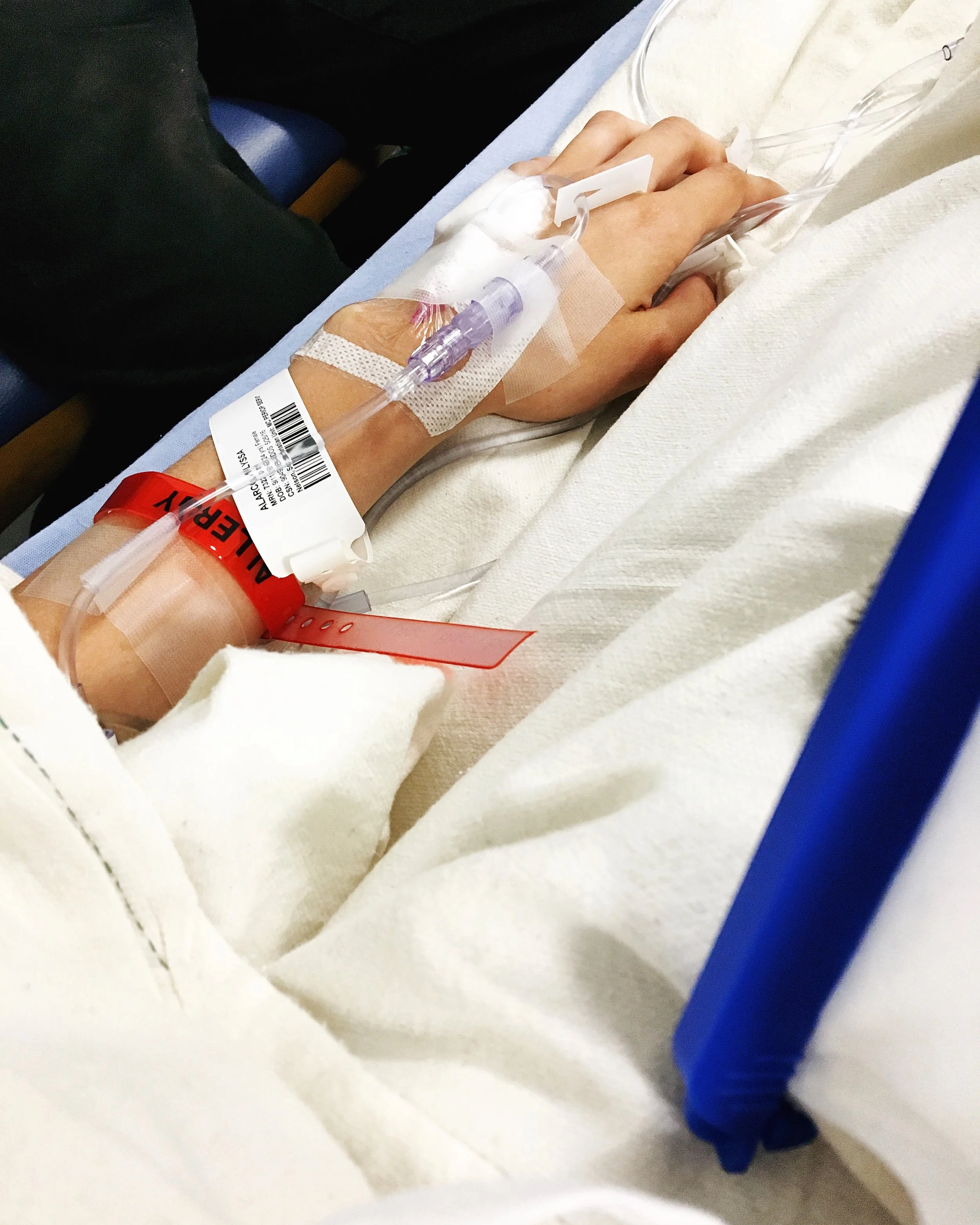
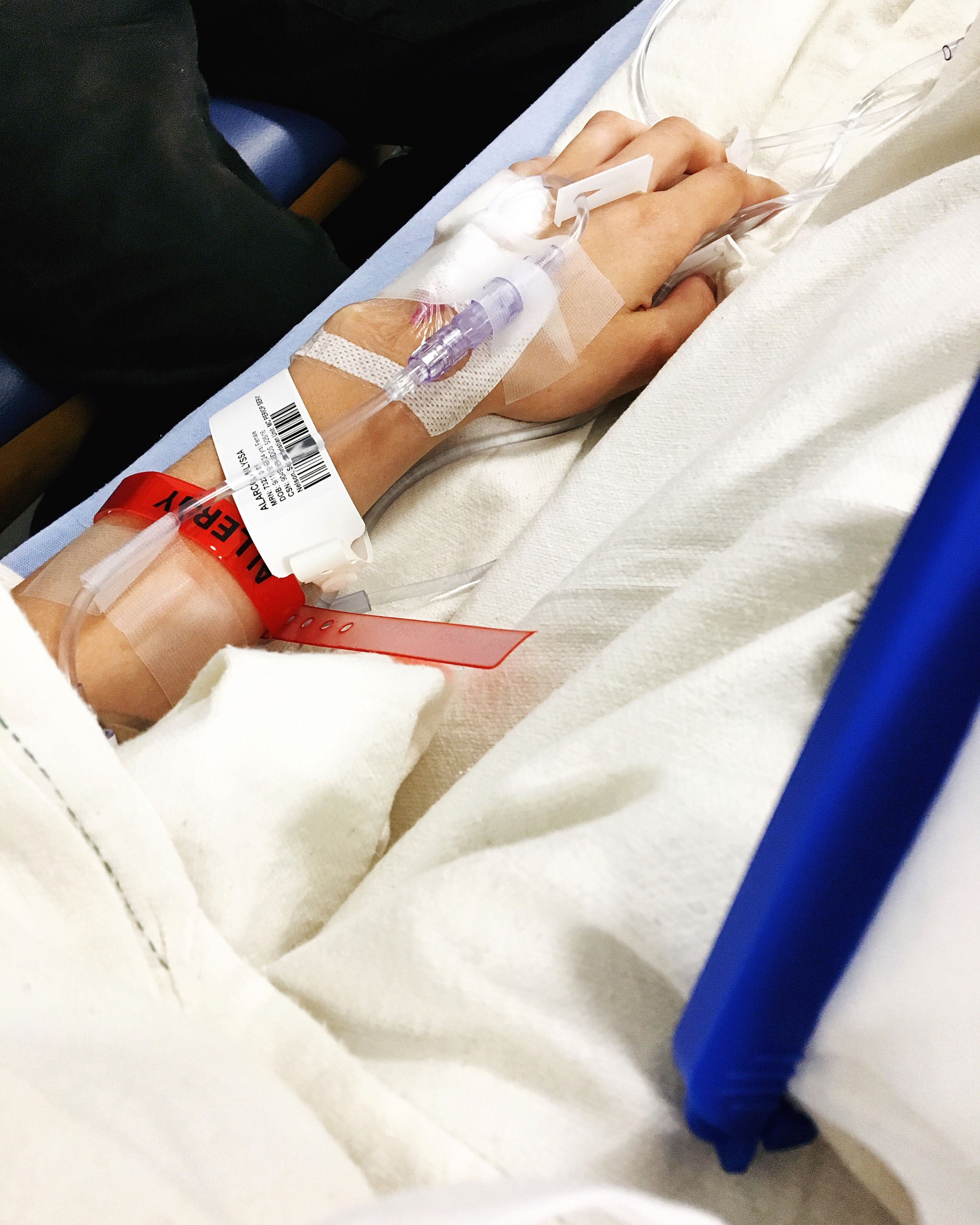
Getting reeeeeally tired of these hospital bracelets
I was desperate for an answer and begged for an ultrasound, finally managing to articulate that it felt like something was inside my body that shouldn’t be. I was correct and within the week - right before Christmas - I had a lemon sized cyst removed from inside of my left ovary. (55mm, for the curious.) My OBGYN said the ovary was so swollen, she could see it from the outside of my body. I went into surgery thinking excellent, onward to recovery. However, I left with Blow Number Three; the soul-crushing label of endometriosis.
Over the years, I’d wondered many times if I perhaps had endo. I’d even brought it up with a doctor or two, who told me that my catastrophic menstrual cramps were just part of the uterus-having experience. My current doctor was horrified when I told her that I have to shut it all down and stay in bed for the first three days of every single period. She was more horrified when she realized I’d been doing that for fifteen years and no one had ever helped me.
The hope was that my symptoms would decrease, at least for the time being, once my massive cyst (which we named Kevin) was fully excised. The surgeon said she saw no further endo and they hoped I’d have a couple of pain-free years before having to tackle this again. Instead, I had to endure a brutal abdominal surgery recovery and the symptoms never so much as decreased. I’ve been in severe pain every single day since mid-October and there’s no end in sight. I’m nearing 28, I’m not coping, and it feels like I’m just biding time until I get hit with Blow Number Four.
I’ve written this to occupy myself while I wait to hear back on yesterday’s ultrasound. Writing has always helped stave off the anxiety, but I have so many questions that keep creeping in. Has Kevin the Cyst regenerated? Are there more of them? Do I name them Kevin too or do they deserve their own names? How much endo was missed during the excision? Why did they miss it in the first place? What if none of this is even related to endo and my symptoms remain a mystery? What if it’s cancer? Oh god, what if it’s cancer? What if I’m in pain for the rest of my life? What happens when I can’t mentally handle the pain anymore? Why does this keep happening to me?
Nothing makes it easier to hear you have yet another incurable condition (especially one that is so difficult to control). Hours and hours of research have left me feeling darker and more hopeless about my future. The prospect of yet another surgery looms overhead. I’m exhausted, everything hurts, and it’s impossible to keep up with the demands of existence when an automatic 60% of my daily energy is siphoned into ignoring the ever-present pain in my left side. I long for the days when I was active and social, young and pretty, or even for the original post-surgery days when I simply wasn’t so isolated. By the fifth surgery, people assume you’re just used to it and don’t visit anymore. They’re right - I am used to it but I never want to be used to feeling so lonely. Life has become a carousel of four doctor's appointments a week, medications that help me with nothing, and the unending stress of being a burden on those I love.
I intended to end this on a more optimistic note about self care, but the truth is that I’m sick of deluding myself into believing that one day, I won’t be sick. Maybe at this point, self care involves telling yourself the truth about your situation and being transparent with others about your struggle.
As I previously stated, endometriosis is incurable, difficult to manage, and severely under-researched. I am filled with rage towards a system that does not value women or reproductive disease. If you feel so compelled, you can donate to endometriosis research here.
Nothing can prepare you for the idea that even after you’ve hit what you feel must be rock bottom, life can still change and once again, become irreversibly worse.

The Miserable Malalignment | An Uncommon Diagnosis
After major surgery, it’s difficult to respond to the myriad text messages from well-meaning loved ones. This brief overview of my situation will have to suffice for the time being.

Here is an x-ray pre-surgery. The orange line is for reference as to where my bones should be.
As is expected post an extensive surgery, I've had a lot of people asking how I'm holding up. I love you all and really appreciate the concern. Also as is expected post surgery, I have been way too out of it to respond much. I figured I would just do a blanket update here so I don't have to repeat myself a hundred times.
Short recap: I have a condition called Miserable Malalignment. It's fairly uncommon, to the point where the majority of my nurses didn't know what it was. Nutshelled, it means that the bones in my legs were rotated in opposite directions, leaving none of my joints stacked, my knees on the inside of my legs, and me legally disabled in the state of Massachusetts. I made the decision last September to get a surgery so intense, it gave me a panic attack the first time I heard what it was. The surgery is called a rotational osteotomy and I needed four of them at once.
I won't lie, last week was actual hell. People kept telling me that it wouldn't be as bad as it was in my head but the truth of it was so, so much worse than anything I could have imagined. I'm doing my best to forget the hospital experience as quickly as I can. The trauma is severe.
The surgery I had is called a rotational osteotomy, which means they break the bone to rotate it and insert a metal rod. I had four - one per femur and per tibia/fibula on each leg - simultaneously. That means six concurrent broken bones. Needless to say, it was an overwhelming and extensive surgery.
I have a short list of things I learned during my six days in Loma Linda.
Don't ever get surgery during a holiday weekend. The doctors you need won't be accessible, there will be very few nurses, and it will be impossible to get your medication in a timely manner.
Make sure your nurses are 100% aware of what surgery you got. Otherwise, don't let them move your legs.
When no one believes you that you're resistant to painkillers, it will take no less than four angry adults (not including you) to get them to listen to you.
When they give you a level 0-10 pain scale, it is possible to reach a 15. It is also possible for your nurse to do nothing and leave you there. Twice. (Resulting in one nurse being written up.)
But then, when you find the one nurse that makes everything seem a little more okay, you'll be really thankful (and feel guilty) that she works twelve hour shifts.
Special thanks to Katie, who mommed me so hard. Dom, who provides impeccable moral support. Brian and Brittany, who drove so far not once but twice. Melissa, who came all the way from Arizona to love me. Vince, who brought flowers, laughs, and didn't mind that I almost immediately fell asleep. Ben and Charly, for sending the most beautiful flowers I've ever gotten. Emily, Brittany, the Santos, and Jay/Eugene/Kat, for the cards and care packages. My inexhaustible parents, for sitting up with me all night, bringing me smoothies, being my advocates and warriors. And Alex, the love of my life, who has gone so far beyond the call of duty, I will never be able to make it up to him. I couldn't have made it through any of this without him softly coaching me through some of the most humiliating moments I can even imagine.

Flowers from Ben and Charly.

Doped as hell, day 2.

The only thing I saw for six days.

My situation for the next several weeks. I can barely stand and walking isn't really feasible until the swelling goes down.

Because my situation sounds like a Series of Unfortunate Events book (which is one of my favorite book series), my amazing mother drew this fake book cover and sent it to Lemony Snicket himself. He sent me this note back, signed as "representative Daniel Handler."
I'm looking at many months of minimal movement and a lot of pain, hoping that my knees will bend one of these days and eventually relearning to walk. Since all my muscles, tendons, and skin are in different places, lord only knows when the pain will subside. Fingers crossed that it's sooner rather than later.
Anyone nearby enough to visit, I would love visitors basically whenever. I have a lot of time to kill.